
The Desk Job Dilemma: Combating Tech Neck and Shoulder Pain with Cupping Therapy
Let’s be direct. You’re probably reading this with your head jutted forward, shoulders rounded, a dull ache already brewing between your shoulder blades. This is The Desk Job Dilemma: Combating Tech Neck and Shoulder Pain and cupping therapy isn’t just a keyword; it’s the daily reality for millions. You trade physical well-being for a paycheck, and your body is sending the bill.
It’s a bad deal. And most of the advice out there is useless. “Just sit up straight!” “Take more breaks!” This is like telling a sinking ship to bail water with a thimble. It misses the point entirely.
Here’s the point: your body adapts to the position you hold most. For 8-12 hours a day, that position is “human slug.” Your chest muscles tighten, your upper back muscles weaken and stretch, and the delicate curve of your cervical spine gets rearranged. This isn’t a minor inconvenience; it’s a structural remodeling that leads to pain, headaches, and reduced mobility.
So let’s stop calling it “poor posture” and start calling it what it is: a repetitive strain injury. And let’s talk about how to fight back, including a hard look at that intriguing, ancient-looking solution: cupping therapy.
What You’re Actually Feeling: The Anatomy of Tech Neck
Before we talk solutions, you need to know what you’re up against. When you crane your head forward to look at a screen, you’re drastically increasing the load on your neck.
Think of your head like a bowling ball. When it’s centered over your spine, it weighs about 10-12 pounds. For every inch it juts forward, the effective weight on your neck muscles and spine doubles. At a 60-degree angle—the standard “texting” pose—your neck is supporting 60 pounds.
Your body isn’t designed for this. The muscles at the back of your neck (your suboccipitals) go into a state of constant, panicked contraction. Meanwhile, the muscles in your upper back (your rhomboids and traps) become overstretched and weak. This tug-of-war creates trigger points—those nasty, painful knots that feel like rocks under your skin.
The pain you feel is a direct signal of mechanical failure. Ignoring it is not an option.
The First Line of Defense: Ergonomic Sabotage
You can’t massage or cup your way out of a problem you spend 40 hours a week creating. So before we discuss any therapies, we need to talk about setting up your environment to do less damage. This isn’t about a fancy chair; it’s about geometry.
- Screen Height:The top of your monitor should be at or slightly below eye level. This keeps your head neutral. If you’re on a laptop, get a stand and a separate keyboard. This is non-negotiable.
- The Elbow Rule:Your elbows should be at a 90-110 degree angle, with your wrists straight. If your chair is too high, you’ll hunch your shoulders. Too low, and you’ll slump.
- The Hip Rule:Your hips should be slightly higher than your knees. This helps maintain the natural curve in your lower back, which supports everything above it.
- The “20-20-20” Rule is a Start, But It’s Not Enough:Every 20 minutes, look at something 20 feet away for 20 seconds. This helps your eyes and cervical muscles relax. But you also need to move.
The Movement Antidote: You Have to Fight Back
Sitting still is the enemy. Your body needs counter-movements. Here are three non-negotiable exercises to do daily. They are simple, but they are not easy if your muscles are tight.
-
The Doorway Chest Stretch
- Why:It directly fights the internal rotation and tightening of your pectoral muscles.
- How:Stand in a doorway, elbows bent at 90 degrees and forearms on the frame. Step forward gently until you feel a stretch across your chest. Hold for 30-45 seconds. Do not arch your lower back.
- Chin Tucks
- Why:This re-teaches your deep neck flexors to do their job, pulling your head back into alignment.
- How:Sit or stand with your back straight. Gently retract your chin, pulling your head straight back as if you’re trying to make a double chin. Do not tilt your head down. Hold for 3-5 seconds, release. Aim for 10-15 reps.
- Scapular Squeezes
- Why:This activates the weakened muscles in your upper back (rhomboids and mid-traps).
- How:Sit or stand tall. Squeeze your shoulder blades together and down, as if you’re trying to hold a pencil between them. Hold for 3-5 seconds. Release. Aim for 15-20 reps.
Do these throughout the day. While waiting for a meeting to start, during a phone call, whenever you think of it.
Where Does Cupping Therapy Fit Into The Desk Job Dilemma: Combating Tech Neck and Shoulder Pain?
Alright, let’s get to the part you’re curious about. You’ve seen the circular marks on athletes and celebrities. Is it a miracle cure or just fancy bruising?
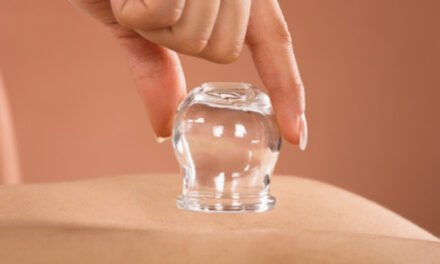
What It Is: Cupping therapy is an ancient form of myofascial decompression. Instead of pushing on muscle tissue (like massage), it uses suction to pull it up. The cups—usually glass, silicone, or plastic—create a vacuum on the skin, lifting the skin, fascia, and superficial muscle layers.
What It Actually Does (The Science):
The theory is that this suction increases blood flow to the area, breaks up fascial adhesions (the sticky stuff that glues your tissues together), and creates a powerful stretch on the muscle and connective tissue. This can stimulate relaxation and healing in tight, overworked muscles.
A study published in the Journal of Bodywork and Movement Therapies found that cupping could improve skin blood flow and increase pain threshold. Another review in Evidence-Based Complementary and Alternative Medicine suggested it may be effective for pain conditions, though more high-quality research is always needed.
The bottom line? It’s not magic. It’s a mechanical intervention for a mechanical problem.
The Two Sides of Cupping: Benefits and the Bruise
The Potential Benefits for Tech Neck and Shoulder Pain:
- Release of Superficial Tension:For the tight, ropey bands in your upper traps and neck, the decompressive lift can provide a release that deep pressure massage cannot.
- Improved Circulation:The stagnant, aching feeling in your shoulders is often a sign of poor circulation. Cupping brings fresh, oxygenated blood to the area.
- Fascial Glide:It can help separate layers of fascia that have become stuck together due to lack of movement and repetitive strain.
The Marks: It’s Not What You Think.
Those circular marks are not bruises in the traditional sense. A bruise (ecchymosis) is caused by trauma that damages capillaries and allows blood to leak into the tissues. Cupping marks (petechiae) are caused by the suction pulling stagnant blood and other fluids to the surface.
A good practitioner will tell you: the darkness of the mark is often less about the “badness” of the tissue and more about the strength of the suction and your own capillary fragility. They typically fade in a few days to a week.
So, Is Cupping Therapy the Answer?
Here is the unvarnished truth.
Cupping is a phenomenal tool for managing the symptoms of tech neck. It can provide significant relief from pain and stiffness. If you’re in a bad way, a session can loosen you up faster than just about anything else.
But it is not a cure.
If you get cupping on Friday and then return to your slouched, static desk posture on Monday, you are simply throwing money at a problem you are actively rebuilding. The relief will be temporary.
Cupping should be viewed as part of a system, not the system itself. It’s the reset button. The real work is what you do every day: your ergonomics, your stretches, your strengthening exercises.
Think of it this way: cupping helps dig you out of the hole. The daily exercises and postural awareness are what stop you from falling back in.
Your Action Plan: No More Dilemma
Stop being a passive victim of your desk. You now have the information. Here is what to do with it.
- Audit Your Setup Today.Spend 15 minutes adjusting your monitor, chair, and keyboard. This is the highest ROI action you can take.
- Schedule Your Movement.Set a timer. Do the three exercises listed above every 60-90 minutes. This is non-negotiable.
- Consider Cupping as a Tactical Tool.If you’re in significant pain, find a qualified practitioner—a physical therapist, certified massage therapist, or acupuncturist who is trained in cupping. Use it to break the cycle of pain, not as a lifelong crutch.
- Build Real Strength.Once the acute pain is managed, you need to get strong. Exercises like rows, face pulls, and deadlifts (with proper form) build the armor that protects you from this dilemma. Consider consulting a physical therapist or a qualified personal trainer.
This isn’t about being perfect. It’s about being consistent. Your desk job doesn’t have to be a life sentence of pain. You have the tools to fight back. Now use them.
Frequently Asked Questions (FAQs)
Q1: How often would I need cupping therapy to see results?
For acute pain, you might start with weekly sessions for 2-4 weeks. For maintenance, once a month or even seasonally might be sufficient. It completely depends on the severity of your condition and, more importantly, the changes you make to your daily habits.
Q2: Are the marks from cupping painful?
The marks themselves are not typically painful to the touch, unlike a bruise. The area might feel a bit tender, similar to a deep muscle ache after a good workout. The sensation usually passes within a day or two.
Q3: I’ve tried stretches and they don’t help. What now?
This usually means one of two things. First, you’re not doing them correctly or consistently enough. Second, the problem may be more complex, involving joint dysfunction or nerve irritation. In this case, it’s time to see a professional. Book an appointment with a physical therapist or orthopedist for a real diagnosis. Don’t just keep guessing.
Q4: Are there any risks to cupping?
When performed by a trained professional, it’s very safe. The most common side effects are the circular marks and temporary tenderness. Burns can occur from fire cupping if done incorrectly, which is why you must choose your practitioner carefully. It is not recommended for people with bleeding disorders, on blood thinners, or with certain skin conditions.
Final Thoughts
The desk job dilemma is real, but it’s not unbeatable. Whether you’re battling tech neck, shoulder pain, or both, small changes can lead to big improvements. And if you’re ready to explore alternative therapies, cupping might be the missing piece of the puzzle.
Your body is your responsibility. Start treating it like it matters because it does.